Live Yoga Teachers
Alignment Yoga
What is alignment yoga?
Alignment yoga is less a single style than a philosophy that runs through several. At its core is one deceptively simple idea: that how you hold a pose matters more than how deep you go into it. Where a flowing class might move you through a dozen postures in a few minutes, an alignment class slows down to ask where your feet, hips, spine and shoulders actually are — and adjusts them, degree by degree, until the pose supports the body rather than strains it.
The approach is most closely associated with Iyengar yoga, developed by B.K.S. Iyengar, who pioneered the systematic use of props and precise anatomical instruction. But the label "alignment yoga" is broader. It's used for any practice that prioritises structural precision and controlled positioning — often described simply as "yoga with props," because blocks, straps, bolsters and blankets are central tools rather than optional extras.
Think of it as the difference between learning a language by immersion and learning it with a grammar book open beside you. Both work. Alignment yoga is the grammar book: it teaches you the underlying rules of each posture so that, over time, every other style you practise becomes safer and more intelligible.
Crucially, it is a still practice rather than a flowing one. You'll hold poses for longer, receive detailed cues, and frequently pause while the teacher explains or demonstrates a refinement. That patience is the point — and for many people, it's a revelation.
What to expect in a class
Workout intensity: low to moderate. This is not a sweaty, cardiovascular workout. You won't be linking breath to rapid movement or flowing through sun salutations at pace. Instead, intensity comes from isometric effort — the quiet, sustained work of holding a posture correctly and engaging the right muscles. Don't mistake gentle for easy: holding a lunge or a standing pose with proper engagement for a minute or more can be surprisingly demanding, and you may feel muscles you didn't know you had. But your heart rate stays relatively low, and there's little to no jumping, pace or momentum.
Fitness level required: accessible to most. Because the practice is slow and highly adjustable, it suits a wide range of bodies and fitness levels — including complete beginners, older participants, and those returning from injury. Props are used precisely so that a posture can be adapted to your body rather than forcing your body into the posture. If you can't reach the floor, a block brings the floor up to you. This makes alignment yoga one of the more inclusive and injury-conscious styles available.
Yoga level required: ideal for beginners, valuable for everyone. Alignment yoga is an excellent entry point precisely because it teaches the foundations properly from the start. Beginners are welcome and well served. That said, experienced practitioners often return to alignment classes deliberately — to correct habits, deepen understanding, and rebuild postures from the ground up. No prior experience is assumed, and the teacher's detailed instruction means you're never expected to already know a pose.
Types of poses to expect. Classes focus on foundational postures held with precision rather than exotic or advanced shapes. Expect:
- Standing poses — Mountain (Tadasana), the Warriors, Triangle (Trikonasana) and Extended Side Angle, which build strength, stability and awareness of the legs and hips.
- Seated and forward folds — often supported with props, working on the spine, hamstrings and hips.
- Gentle backbends and twists — to mobilise the spine safely.
- Restorative and supine poses — supported reclining postures that open the chest and release tension.
- Inversions in supported form — sometimes legs-up-the-wall or prop-assisted variations, depending on the class level.
The emphasis throughout is on doing fewer poses well, holding them longer, and understanding the anatomy of each — rather than covering a lot of ground.
Props required. Props are essential, not optional, and our livestream teacher will tell you what to have to hand before class. Typically:
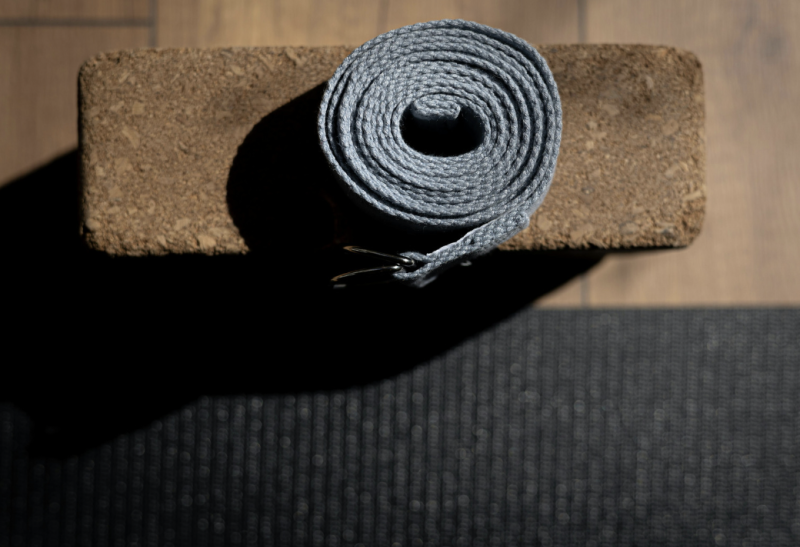
- Two yoga blocks — for support, height and stability.
- A strap (or a belt/scarf as a substitute) — to extend your reach in folds and binds.
- A bolster or firm cushion — for supported and restorative poses.
- One or two blankets — for padding, warmth and lift under the hips or knees.
- A wall — frequently used for standing poses and inversions, so it's worth setting up near one.
- A non-slip mat.
For an online class, it's worth gathering these before you begin so you're not scrambling mid-session. Household substitutes work fine when you're starting out — sturdy books for blocks, a dressing-gown belt for a strap, a couch cushion for a bolster.
Benefits of alignment yoga
Better posture and body awareness. This is the signature benefit. By training you to notice and correct your positioning, alignment yoga builds a heightened sense of where your body is in space — awareness that carries off the mat into how you sit, stand and move through daily life.
Safer practice and injury prevention. Because the style teaches correct technique and uses props to protect the joints, it significantly reduces the risk of the strains and overextensions that can come from rushing through poses. For anyone with a history of injury, or who's nervous about "doing it wrong," this is reassuring ground.
Strength and stability. Holding postures with proper engagement builds deep, stabilising strength — particularly in the legs, core and the small supporting muscles around the joints — in a controlled, low-impact way.
Improved flexibility, gradually. Sustained, well-supported holds allow muscles to lengthen safely over time, improving flexibility without the risk of forcing.
A foundation for every other style. Perhaps the most underrated benefit: what you learn in alignment yoga makes you better at all yoga. Once you understand how a posture is meant to be built, flowing classes, power yoga and home practice all become safer and more rewarding.
Calm and focus. The slow pace, the concentration required to hold and refine each pose, and the emphasis on breath make alignment yoga quietly meditative. Many participants leave feeling both physically worked and mentally settled — a rare and welcome combination.

 Summary
Our Alignment Yoga teachers