Live Yoga Teachers
Yoga for Mental Health
Yoga has an impact on the nervous system, which other sports don't have. Everyone feels better after working out, as endorphines are being released, but yoga has a deeper long lasting effect.
Yoga is often recommended for mental health, and anyone who practices regularly can speak to the mood boost and many other benefits it provides.
Each yoga pose affects your body differently, and every type of practice offers its own benefits.
It's always better to pick a type of yoga that you actually enjoy. Take our yoga quiz to find your perfect match!
Yoga is consistently recommended to individuals with mental health issues
Workout is often a repetition of the same movement, at various speed and intensity. But yoga is a combination of many different movements. With yoga you could be:
- Sitting, lying down, standing, inverting
- Stretching, pressing, opening, balancing
- Moving, being still, breathing, meditating
- Grounding, releasing, relaxing, surrendering
These different practises and poses have different effect on the body, which you can't find in other sports. Some ball games are a little more involving different parts of the body, but the “competition” spirit in these kind of sports will exacerbate your ego and won’t help relax and let go.
How specific poses interact with your biology
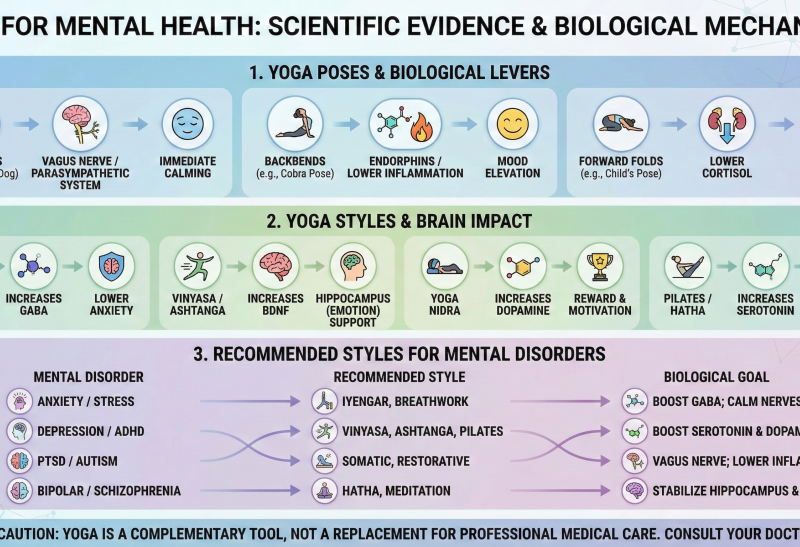
Different physical poses can act like "biological switches" in the body. By changing our posture, we can physically stimulate nerves and glands that signal the brain to either calm down or wake up.
- Inversions (e.g., downward dog) and the vagus nerve: when your head is below your heart, it signals a major nerve called the Vagus Nerve to slow your heart rate, moving you from "fight-or-flight" into a "rest-and-digest" state. Other inversions are headstand, shoulder stand or just legs up the wall.
- Backbends (e.g., cobra pose) and endorphins: opening the chest can help reduce inflammation markers in the body and trigger the release of endorphins, which are the body’s natural painkillers and mood lifters.
- Forward folds and cortisol (e.g., standing forward fold): gentle folding poses help lower cortisol (the stress hormone) by calming the adrenal glands and quieting the brain's electrical activity.
Balance Poses (e.g., half moon pose) and the cortex: staying steady requires the cortex (the thinking part of the brain) to work hard, which helps strengthen your ability to focus and stay calm under pressure.
| Pose Group | Biological Mechanism | Main Benefit |
| Inversions | Vagus nerve / parasympathetic system | Immediate calming |
| Backbends | Endorphins / lower inflammation | Mood elevation |
| Forward Folds | Lower cortisol | Stress reduction |
| Balances | Cortex & grey matter activation | Improved focus |
Source: Medical Hypotheses - Yoga and Polyvagal Theory, Oxidative Medicine and Cellular Longevity - Yoga and Inflammation, Journal of Clinical and Diagnostic Research - Yoga and EEG, Frontiers in Human Neuroscience - Yoga and the Brain
How different yoga types impact your biology and your brain
Every type of yoga is different and triggers unique chemical reactions in the brain, from boosting "happy" chemicals like serotonin to growing important brain structures.
- Iyengar yoga and GABA (Gamma-Aminobutyric Acid) : because it focuses on very precise alignment and long holds, Iyengar yoga has been shown to increase GABA, a chemical that acts as a natural "brake" for anxiety in the brain.
- Vinyasa and BDNF (brain-derived neurotrophic factor): the faster, flowing movement of Vinyasa increases BDNF, a protein that acts like "brain fertilizer," helping the hippocampus (the memory and emotion center) grow and stay healthy.
- Yoga nidra and dopamine: this deep relaxation practice can increase dopamine (the reward chemical) by up to 65%, helping you feel more motivated and less "burnt out."
Pilates and serotonin: the mindful resistance in Pilates triggers the release of serotonin, which helps regulate mood, sleep, and appetite.
| Yoga/Wellness Type | Chemical/Biological Shift | Key Area Impacted |
| Iyengar | Increases GABA | Lower anxiety |
| Vinyasa / Ashtanga | Increases BDNF | Hippocampus (Emotion) |
| Yoga Nidra | Increases dopamine | Reward & motivation |
| Pilates / Hatha | Increases serotonin | Mood stability |
| Breathwork | Vagus nerve stimulation | Nervous system balance |
Source: Journal of Alternative and Complementary Medicine - GABA & Yoga, Frontiers in Psychology - Physical Exercise and BDNF, Cognitive Brain Research - Dopamine and Yoga Nidra, Frontiers in Psychology - Pilates and Mental Health
Recommended yoga types for mental health disorders
While everyone is different, clinical studies suggest that certain types of yoga are better suited for specific mental health challenges. We recommend these styles as "supportive" practices to be done alongside your doctor's advice.
- Depression and vinyasa: rhythmic, flowing movement helps lift the "heaviness" of depression by boosting serotonin and endorphins.
- Anxiety and iyengar/breathwork: precise poses and controlled breathing help increase GABA and soothe a hyper-active sympathetic nervous system (the stress response).
- PTSD and somatic/restorative: for trauma, gentle styles that focus on "feeling" the body safely are best for reducing inflammation and calming the fear center of the brain.
- ADHD and ashtanga/pilates: yoga types that require high concentration and "core" work help regulate dopamine and strengthen the cortex for better focus.
Burnout and yin/sound bath: these practices focus on "non-doing" to help lower chronic cortisol and restore the nervous system.
| Mental Disorder | Recommended Style | Biological Goal |
| Anxiety / Stress | Iyengar, breathwork | Boost GABA, calm nerves |
| Depression / ADHD | Vinyasa, ashtanga, pilates | Boost serotonin & dopamine |
| PTSD / Autism | Somatic, restorative | Vagus nerve, lower inflammation |
| Bipolar / Schizophrenia | Hatha, meditation | Stabilize hippocampus & cortex |
| Burnout / Eating Dis. | Yin, sound bath, nidra | Lower cortisol, body awareness |
Source: The Lancet Psychiatry - Exercise for Mental Health, Journal of Psychiatric Practice - Yoga for Anxiety, Journal of Traumatic Stress - Yoga for PTSD, Scientific Reports - Yoga for ADHD, Frontiers in Psychology - Yoga for Burnout
Always check with your doctor
Yoga is a beautiful way to support your mental health, but it is not a replacement for professional medical care, therapy, or medication. Always talk to your doctor before starting a new physical routine, especially if you are managing a clinical condition.

 Summary
Our Yoga for Mental Health teachers