Live Yoga Teachers
Half Moon Pose
Ardha Chandrasana

Half Moon Pose is a standing balance that opens the whole body into the shape of a crescent moon. Balancing on one hand and one foot, you lift the opposite leg parallel to the floor and reach the top arm to the sky. It's a pose that asks for focus as much as strength — challenging your balance while stretching you from your standing foot all the way to your fingertips. It's most often entered from Triangle Pose.
What does Ardha Chandrasana mean
Ardha Chandrasana comes from "ardha" (half), "chandra" (moon), and "asana" (pose or seat) — "half-moon pose," named for the curved, crescent shape the body makes in the balance.
How to perform Half Moon Pose
1 · How to enter safely
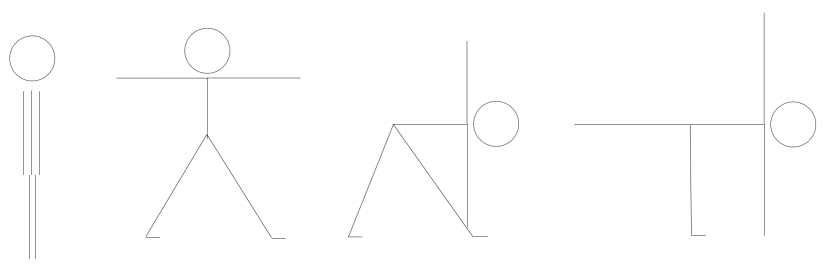
- Start in Mountain Pose. Lift your kneecaps, spread your toes, and settle your focus for the balance ahead.
- Step or lightly jump your feet wide and extend your arms to shoulder height. Turn your left foot slightly in and your right leg out to the right, then reach out and lower into Triangle Pose over your right leg.
- From Triangle, place your right hand on the floor about 10 cm beyond your right little toe, and bring your left (back) foot in a little.
- Press into your right hand and foot, lift your left leg up until it's parallel to the floor, and straighten your right (standing) leg. Stack your hips, open your chest, and extend your left arm toward the ceiling.
- Find your balance on the one hand and foot, gazing straight ahead.
2 · How to hold the pose
Once you're steady, keep both legs active — reach strongly out through the lifted heel and lengthen from that foot all the way to the crown of your head. Keep stretching through both arms and draw your chest open, turning it toward the ceiling. Press firmly through your standing foot and lower hand for a stable base. If you feel steady and your neck is comfortable, you can turn your head to gaze up at your top hand. Breathe evenly and hold for several breaths, then repeat on the other side.
3 · How to exit safely
- Come out carefully: bend your standing leg a little and reach your lifted (left) leg back down with a big step, returning to Triangle Pose.
- Rest in Triangle for a moment, re-stretching through the arms and legs.
- Press your feet down, lift your torso back up to centre, turn your toes forward, and step or lightly jump back into Mountain Pose. Then repeat on the second side.
Benefits of Half Moon Pose
Half Moon Pose stretches the whole body — across the chest and the top arm, and along the entire lifted side from toes to crown — while strengthening the standing leg, ankle, and the core that keeps you balanced. As a balancing pose, it also builds focus and a sense of calm steadiness, on and off the mat.
Who can perform Half Moon Pose
Half Moon is an intermediate balancing pose — most people meet it once they're comfortable in Triangle Pose, which it grows out of. You don't need much flexibility, but you do need to work on balance, and that comes with practice. A wall behind you and a block under your lower hand make it far more accessible while you find your steadiness, so it's well within reach for improving beginners.
Types of yoga that use Half Moon Pose
Half Moon Pose appears in standing sequences across Vinyasa, Hatha, and Iyengar, often practised right after Triangle Pose since the two flow so naturally together.
Half Moon Pose variations
There are a few ways to explore the pose. Sugarcane Pose (Ardha Chandra Chapasana) bends the lifted leg and catches the foot with the top hand for a backbend and quad stretch. Revolved Half Moon (Parivrtta Ardha Chandrasana) twists the torso toward the standing leg with the opposite hand down. And a supported Half Moon — lower hand on a block, back to a wall — is the most useful variation of all while you build balance.
Required props and best mat
Two props make all the difference here. A block (brick) under your lower hand raises the floor to you, so you can open the chest and lift the leg without collapsing — place it just beyond your standing foot's little toe. A wall behind your back gives you something to lean lightly against while you learn to stack the hips and find your balance. A non-slip mat helps keep your standing hand and foot steady.
Risk and injury prevention
- Balance difficulties or dizziness — practise with your back to a wall and a block under your hand.
- Low blood pressure — come up slowly, and keep your gaze forward rather than up.
- Neck issues — look straight ahead instead of turning to gaze at the top hand.
- Ankle or knee injuries (standing leg) — keep a micro-bend in the standing knee, don't lock it, and skip the pose if it's painful.
- Pregnancy — use a wall and block for stability, and avoid the revolved variation.
Alternative poses and modifications
If full Half Moon isn't right for you today, a few options give a similar stretch or balance challenge with more support. Triangle Pose offers much of the same side-body length with both feet grounded — the natural place to build from. Supported Half Moon at a wall, with a block under the lower hand, lets you find the shape without the full balance. And Tree Pose is a gentler standing balance for developing the steadiness Half Moon asks for.

 Summary