Live Yoga Teachers
Postnatal Yoga
Postnatal Yoga
After birth, your body needs time to recover and rebuild. Postnatal yoga (also called postpartum yoga) gives you a steady way to do that. It focuses on the things pregnancy and delivery ask the most of — your core, your pelvic floor, your posture, and your breath — and it meets you wherever your recovery is.
You don't need to be flexible, fit, or experienced. You need a bit of space and a few quiet minutes. The rest builds from there.
When can you start yoga after birth?
In the early weeks, keep it gentle: slow breathing and light pelvic-floor awareness are enough, and you can do them while you feed or rest. For fuller movement, wait until after your six-week check and your GP or midwife has cleared you. If you had a caesarean, that's usually a little later — often around eight to ten weeks.
Recovery isn't linear. Some days you'll have energy to move; other days rest matters more. Both are fine.
How postnatal yoga helps
Pregnancy stretches and separates the abdominal muscles, loads the pelvic floor, and shifts your posture. Then feeding and carrying pull you forward all day. Postnatal yoga works through this in order — reconnecting the deep core with the breath, strengthening the pelvic floor, and opening the chest and upper back to undo the hunch.
It steadies more than the body. Slow movement and longer exhales calm an overstretched nervous system, which helps with the broken sleep, the mood swings, and the low-level overwhelm of early parenthood. Ten minutes can be enough to feel more like yourself.
Yoga after a caesarean
A c-section is major surgery, so recovery takes longer. Start with breathing and gentle mobility once you're cleared, usually around eight to ten weeks. Ease into deep core work and strong twists rather than rushing them, and stop if anything pulls near the scar. A slow start protects the healing underneath.
Yoga for diastasis recti
Diastasis recti is the natural separation of the abdominal muscles during pregnancy. It's common, and gentle yoga can help it close by rebuilding the deep core with breath-led movement. Skip crunches, full planks, and deep backbends until it's healed — they push the gap wider. The right cues make the difference, which is where a live teacher helps.
Adapting your practice as you recover
0–6 weeks: Rest first. Slow breathing and gentle pelvic-floor awareness — no strain, no schedule.
6 weeks–6 months: Once you're cleared, begin gentle movement: restorative poses, light core reconnection, simple stretches. Progress slowly.
6 months+: Build gradually toward stronger, longer practice — guided by your energy, not a deadline.
Which classes to choose
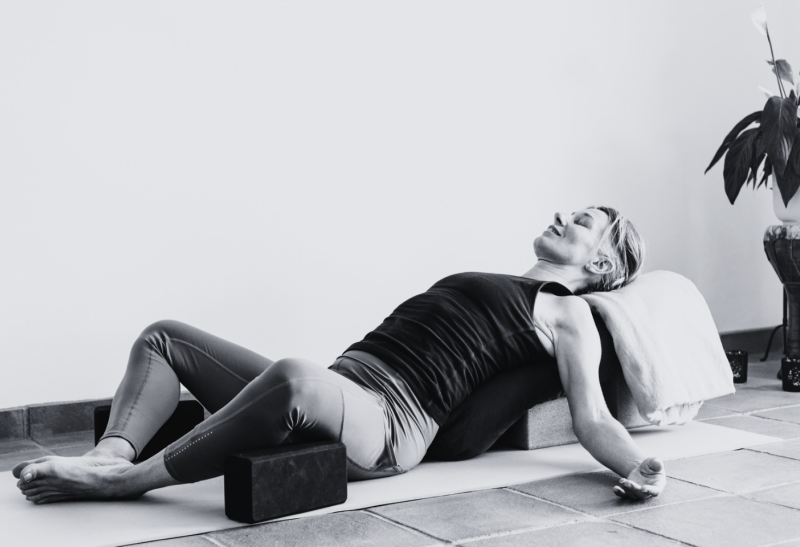
We don't always run classes labelled "postnatal" — but several of our live yoga types give you the same gentle recovery. Start with Gentle yoga or Restorative yoga for slow, supported movement, or Somatic yoga to rebuild awareness of your core and pelvic floor.
Hatha moves at an unhurried pace, and Pranayama sessions are pure breathwork — good in the early weeks, or any day your energy is low.
When you join, let the teacher know you're recovering after birth, and they'll offer gentler options.
Practising at home with a newborn
A fixed class time and an unpredictable baby don't always agree — so keep it simple. Our live classes run in small groups, and you're welcome to have the baby nearby. Feed mid-class, step away, come back. No one minds, and you won't be the only one. You can book a class once the baby is already asleep so you know you'll be able to attend.

 Summary