Live Yoga Teachers
Face Yoga
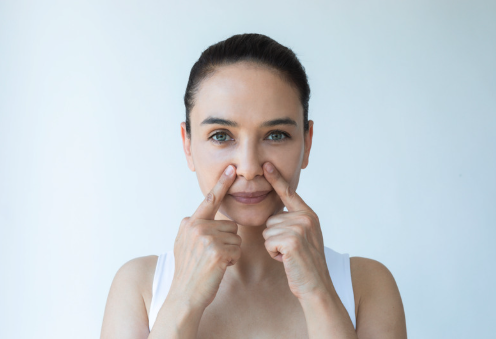
What is face yoga?
Face yoga is a practice of gentle exercises, self-massage and slow breathing for the muscles of your face, jaw and neck. You don't need a mat or any flexibility, just a few quiet minutes and your own two hands.
There are around 40 muscles in the face, and most of us only use a handful of them, often the same way all day: a furrowed brow at the screen, a clenched jaw in traffic. Face yoga asks you to notice those habits, move the muscles you've forgotten, and let go of the ones that are working too hard. Most people come to it to look a little fresher. Many stay because it feels so calming.
Where face yoga comes from
Face yoga is a modern practice, not an ancient one. Traditional hatha yoga does include a few movements for the face. Lion Pose (Simhasana) is the best known, with its wide-open mouth, stretched tongue and strong exhale. But face yoga as its own style only took shape in the last few decades.
A handful of teachers shaped it. Fumiko Takatsu, an English teacher living in Japan, developed the Face Yoga Method after a car accident left her face looking uneven. In the US, Gary Sikorski built a routine called Happy Face Yoga. In the UK, Danielle Collins reached a wide audience through free video tutorials. By the late 2010s, face-workout studios had opened in New York, Los Angeles and London.
So face yoga borrows the spirit of yoga, with its breath, attention and gentle effort, more than any particular lineage. That's worth knowing, and it's nothing to be put off by. It simply means you're joining a young practice that's still finding its shape.
What a face yoga session looks like
A face yoga class is short and quiet, usually 15 to 30 minutes, and you can do the whole thing sitting on a chair or on the sofa. Start with clean hands and a clean face, and keep a mirror nearby if you like. In a live class, your teacher can see you and help you adjust as you go.
Most sessions follow a similar shape:
- Arrive and breathe. A few slow breaths to settle, with the shoulders soft and the jaw loose.
- Warm up. Gentle tapping or light massage across the forehead, cheeks and jaw to bring warmth to the skin.
- Release. Slow pressure along the jaw, temples and brow, the places where tension tends to hide.
- Strengthen. Small, controlled movements held for a few breaths, such as lifting the cheeks into a smile or gently resisting with a fingertip.
- Stretch. Lengthening moves for the face and neck, such as a soft Lion Pose or a slow chin lift towards the ceiling.
- Rest. A minute of stillness, letting the whole face soften before you go back to your day.
The movements are small, and some of them look a little funny. That's part of the fun, and at home, nobody but your teacher is watching.
Benefits of face yoga
The most reliable benefit of face yoga is the one you feel straight away: a softer jaw, a less heavy brow and a calmer few minutes. Many of us hold stress in our faces without noticing. Giving those muscles attention, then letting them rest, can feel like setting down a bag you didn't know you were carrying. Face yoga is also an easy daily habit, since it needs no kit, no change of clothes and very little time.
What about looking younger? The research is early but encouraging. In a 2018 Northwestern University study, women aged 40 to 65 did 30 minutes of facial exercises daily for eight weeks, then every other day until week 20. Dermatologists rating their photos saw fuller upper and lower cheeks, and the women's estimated age fell by about three years on average. However, only 16 women finished the study, and the researchers say it needs repeating with larger groups.
Face yoga is a gentle way to relax your face and care for it, and it may help it look a little fresher over time. It isn't a facelift, and it won't change the shape of your face overnight. Doing a few minutes most days matters more than doing a lot occasionally.
Who face yoga suits
Face yoga suits almost anyone, and complete beginners are very welcome. You don't need any strength, flexibility or experience with yoga. Because it's done sitting down, it also works well if getting down onto a mat isn't easy for you right now.
It's a good fit if you clench your jaw or frown at a screen, or if you'd like a short practice that fits into a busy day. It also works as a calm way to close a longer class, or simply as a few minutes of care for your face before bed.
Go gently and check with your doctor first if you have jaw joint (TMJ) pain, a recent facial injury or surgery, or Botox or fillers in the last few weeks. If any movement causes pain, stop and let your teacher know, and they'll offer you a softer version.
Face yoga vs other yoga types
Face yoga is the smallest and quietest style of yoga. It works on the face and neck rather than the whole body, so it sits alongside your usual practice rather than replacing it. if you enjoy quiet practises this will fit perfectly other yoga types like yoga nidra, sound bath, restorative yoga or yin yoga.

 Summary