Live Yoga Teachers
How much is a yoga class? The Live Yoga Teachers Price Index
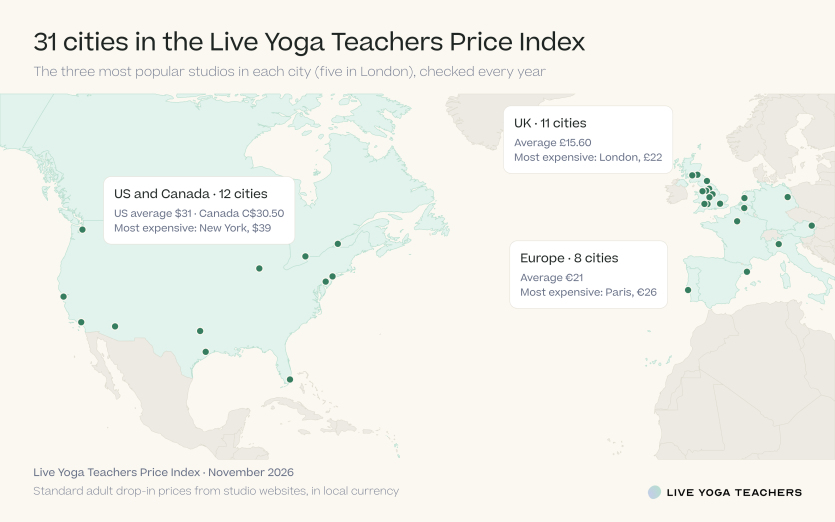
A drop-in yoga class at a popular studio now costs an average of £15.60 in the UK, $31 in the US, C$30.50 in Canada and €21 in Europe. In the most expensive cities, London, New York and Paris, it's £22, $39 and €26.
These numbers come from the Live Yoga Teachers Price Index, our yearly check of what the most popular yoga studios charge. This page explains what the index is, why we started it, and what it found in its first edition.
What is the Live Yoga Teachers Price Index?
The Live Yoga Teachers Price Index tracks the price of a yoga class at the most popular independent studios in the UK, North America and Europe. Its purpose is simple: to show how studio prices change over time.
How the index is built
The first edition covers 95 studios in 31 cities: 11 in the UK, 12 in the US and Canada, and 8 in Europe.
In each city, we looked at which studios rank on Google for local searches, such as "yoga Manchester", "yoga studio Chicago" or "cours de yoga Paris". Then we compared how many people visit each studio's website from search (measured with Ahrefs) and how many people follow each studio on Instagram. We kept the top three in each city, and five in London.
For each studio, we recorded two prices: a single drop-in class and a 10-class pass. Every price comes from the studio's own website, in local currency. We used the standard adult price and left out intro offers, student rates and sales.
We left out national chains, franchises, gyms and booking apps, because their prices are set centrally or aren't comparable. When a popular studio only showed its prices inside an app, we used the next most popular studio that publishes them.
How often we update it
We'll update the index once a year, each November. Every edition tracks the same studios in the same cities, so the results can be compared year on year. When a studio closes, we'll say so and replace it with the next most popular studio in that city. The next edition is due in November 2027.
The studio market is having a hard time
Yoga studios have been under pressure for six years, and it hasn’t stopped. During lockdown, many earned almost nothing for months at a time. Since then, rent and running costs have gone up, and fewer people come to class, perhaps because so many now work from home part of the week. To stay afloat, many studios have raised their prices. But higher prices can push away the very students they need.
Lockdown closed studios for good
When the pandemic hit in 2020, studios had to close their doors overnight. Many never reopened.
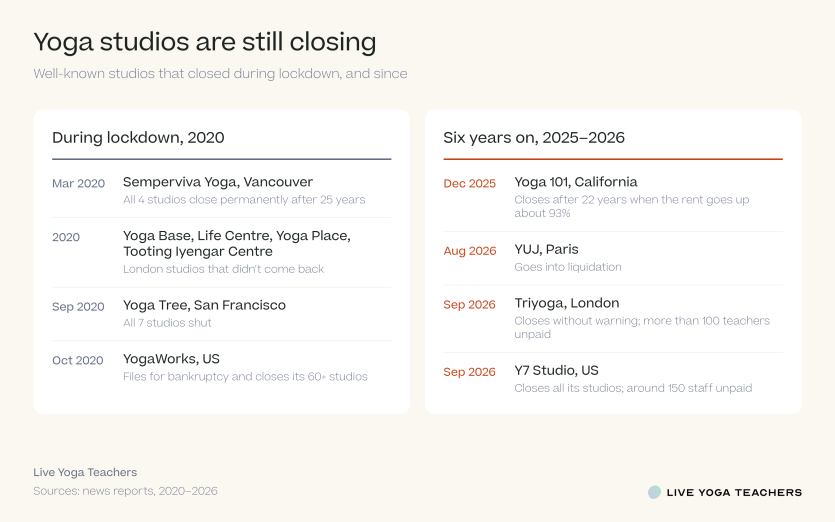
In London, Yoga Base and Life Centre in Islington, Yoga Place on Bethnal Green Road and the Tooting Iyengar Centre all closed. In our own survey of UK teachers at the time, 9% said the studio they taught at had closed permanently.
North America was hit just as hard. Semperviva Yoga, a Vancouver institution with four studios, closed permanently in March 2020 after 25 years. It cited cancelled memberships and rising lease costs. In September 2020, Yoga Tree shut all seven of its studios in San Francisco and Berkeley. A month later its owner, YogaWorks, one of the biggest studio groups in the US with more than 60 locations, filed for bankruptcy and closed all of its studios.
The closures haven't stopped
Studios reopened in 2021, but many came back with smaller classes, higher costs and fewer regular students. Six years on, popular studios are still closing.
Triyoga opened in Primrose Hill in 2000 and became one of London's best-known studios. In September 2026, its studios closed without warning. Bailiffs had visited the Shoreditch studio in August, and more than 100 teachers were left unpaid. Its parent company, Common Bond, closed its other London studios at the same time, including Barrecore, Boom Cycle and KOBOX. Members who had prepaid for a year were left without classes.
In the US, Y7 Studio, a popular hot yoga chain that once had 15 studios, closed all of its remaining locations in September 2026. Around 150 staff were left with weeks of unpaid wages. Its owner, Fitlab, filed for bankruptcy a few weeks later.
Smaller studios are closing too, often because of rent. Yoga 101 in Leucadia, California, closed in December 2025 after 22 years, when its landlord proposed a rent increase of about 93%. In Paris, YUJ, a well-known hot yoga studio, went into liquidation in August 2026.
At the same time, fewer people are going to yoga studios. In England, the share of adults who practise yoga fell from 4.2% before the pandemic to 3.8%, according to Sport England. Reformer Pilates and other workouts have taken some of the students that studios relied on.
Prices are higher than before
We practise yoga ourselves, and we noticed the change after lockdown. A drop-in class at our favourite studios used to cost under £15. By 2022, it was £18, and prices have kept rising since.
Higher prices may be one reason people are practising less. That’s a shame, because the NHS says that gentle activities like yoga can relieve stress, depression and anxiety. And since lockdown, more people than ever need that support. It’s one of the reasons we believe live online yoga can help: it keeps a regular practice within reach.
Where you live changes what you can find
Studios aren't spread evenly. Most are in big cities, where there are enough students to fill a timetable. Outside cities, there's often very little choice.
We saw this while building the index. In London, New York or Paris, we had dozens of studios to choose from. In smaller cities, it was harder to find three popular studios that publish their prices. In Vancouver, none of the most popular studios did.
The gap is even bigger in the countryside. One US study found that studios in rural south-west Virginia offered about 8 classes a week on average, compared with 24 in Los Angeles. In many rural areas, the nearest class is a long drive away, if there is one at all. That means more time, more travel costs and fewer chances to practise.
Why we believe in live online classes
Studios do a lot of good. Many students love the space, the teachers and the people they meet there. But the numbers in this index show a real problem: a regular studio practice is expensive, and in many places it's getting harder to find.
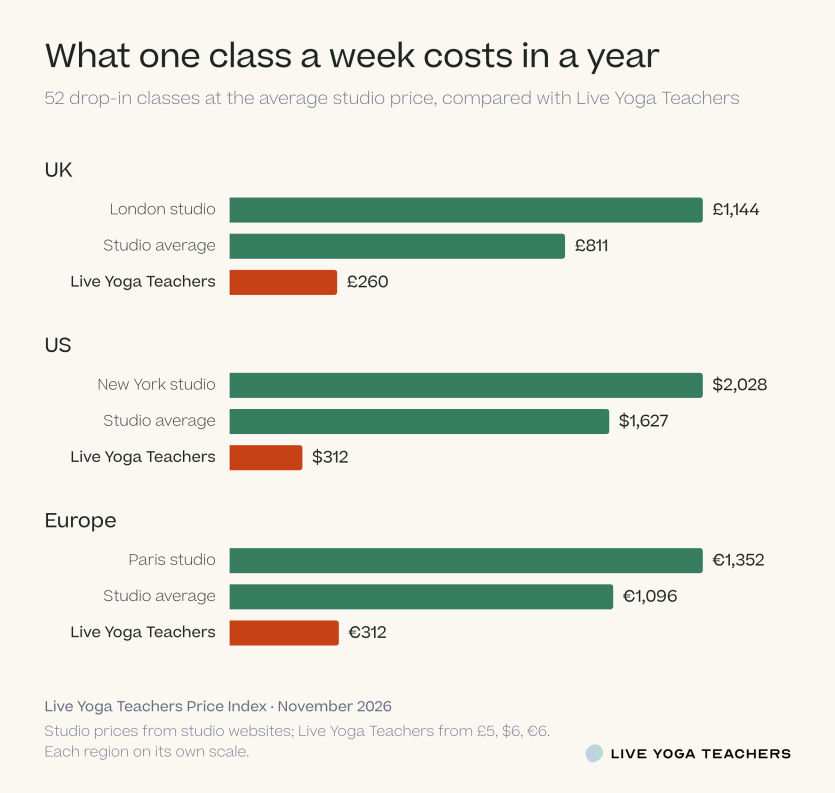
At the average UK price, one class a week costs about £810 a year. In London it's over £1,100. In New York it's over $2,000. That's a lot of money for something that should be good for everyone. We don't want yoga to become a practice only for people who can afford it.
Live online classes work differently. Our teachers stream live from their own space to yours, so there's no studio rent built into the price. With a lower cost base, classes can stay affordable, and the model doesn't depend on a lease, a landlord or a full room every night. That makes it more sustainable for teachers and students alike.
At Live Yoga Teachers, drop-in classes start from £5 in the UK, $6 in the US and Canada, and €6 in Europe. It's still a real class: it starts at a set time, a teacher leads it and can see you, and you practise alongside other students in this community. And it's the same class whether you live in central London or a village two hours from the nearest studio.
A £5 class is how we make yoga open to more people. One class a week at that price is around £260 a year.
What the 2026 index found
UK: £15.60 a class
The average drop-in class at a popular UK studio costs £15.60, and a 10-class pass costs about £120. London is the most expensive city, at £22 a class, about 40% above the UK average. Liverpool (£11.50) and Cardiff (£12.17) are the most affordable.
US and Canada: $31 a class
The average drop-in class at a popular US studio costs $31, and a 10-class pack costs about $242. New York is the most expensive city, at $39 a class. Phoenix and Seattle are the most affordable US cities, at $27. In Canada, the average drop-in is C$30.50, with Toronto and Montreal both close to C$30.
Read about US and Canada Yoga prices →
Europe: €21 a class
Across eight European cities, the average drop-in class costs €21, and a 10-class pass costs about €163. Paris is the most expensive city, at €26 a class, followed by Berlin. Amsterdam, Lisbon and Barcelona are the most affordable, at €18 to €19.50.
Read about Europe Yoga prices →
In every region
A 10-class pass saves about 20–25% compared with single classes, but passes often expire within a few months. Monthly memberships are now common everywhere, and some studios no longer sell class passes at all. Many popular studios only show their prices inside a booking app, so it's worth checking before you sign up.
About this data
Prices were collected from each studio's own website on 13 and 14 November 2026. The index covers independent and locally run studios and leaves out gyms, booking apps and national chains. Prices are shown in local currency and haven't been converted. Averages only include studios that publish a price for that option. Studio prices change often, so check with a studio directly before booking.
 Summary